
Many businesses respond to slow growth by increasing execution. They hire more salespeople, launch campaigns, redesign websites, improve delivery processes, or introduce new features. These actions can help when execution is the problem. But when customers cannot understand what the business offers, who it serves, or why its solution matters, additional activity may simply increase the cost of an unresolved positioning problem.
An unclear business offer is not necessarily a poor product or service. It is a proposition that does not communicate enough customer value to support a confident buying decision.
A business may have strong technical capabilities, experienced employees, and satisfied customers while still struggling to explain its commercial value.
Want to identify what is holding your offer back?
Sharpen your offer before investing in more execution.
What Is an Unclear Business Offer?
An offer is more than a description of what a company sells. It connects a specific customer problem to a solution, an expected outcome, and the commercial conditions under which that solution is delivered.
A clear offer should help a potential customer answer five questions:
- Is this intended for a business like mine?
- Does it address a problem I currently recognize?
- What outcome should I expect?
- Why should I choose this approach over an alternative?
- What must I commit in money, time, or resources?
If these answers are missing, the buyer must interpret the offer independently.
Consider a technology services company that introduces itself as a provider of AI, IoT, cloud, and software development solutions.
That description communicates technical capabilities. It does not explain which customer should engage the company or what business problem it is best positioned to solve.
Compare it with:
“We help industrial equipment manufacturers connect existing machines to cloud monitoring systems without replacing their control infrastructure.”
The second statement identifies a customer, an operational challenge, and a practical solution boundary.
It does not guarantee a sale. It gives the buyer enough context to decide whether the conversation is relevant.
Offer Clarity Versus Execution Quality
Execution describes how effectively a company delivers its work. Offer clarity describes how effectively it defines the value customers are being asked to purchase.
These are related but separate capabilities.
A development team might complete every sprint on schedule while the commercial team struggles to explain why prospects should approve the project.
A consulting business might deliver excellent recommendations but present its services through broad terms such as transformation, innovation, and growth.
In both situations, improving delivery performance alone may not address the commercial bottleneck.
| Dimension | Execution problem | Offer clarity problem |
|---|---|---|
| Primary symptom | Missed commitments | Weak buyer understanding |
| Customer concern | Can they deliver? | Why should we buy? |
| Typical response | Improve processes | Refine positioning |
| Evidence | Delays, defects, rework | Confusion, objections, low relevance |
| Useful measure | Delivery reliability | Qualified buyer response |
The distinction matters because the corrective actions require different investments.
Why Offer Clarity Matters More as Businesses Grow
Early-stage businesses often develop their offers through direct conversations.
A founder meets a customer, understands a problem, proposes a solution, and adjusts the scope. The founder’s personal involvement compensates for weaknesses in the formal offer.
As the company grows, that approach becomes harder to repeat.
Salespeople need consistent messages. Marketing teams need defined audiences. Delivery teams need boundaries. Customers need to understand what is included and excluded.
Without those definitions, each function may develop a different interpretation of the same business.
How Activity Can Hide a Positioning Problem
Imagine a consulting company generating 100 inquiries per month.
Only 20 inquiries match its actual capabilities, and just five develop into serious commercial discussions.
Management might conclude that it needs more leads.
Doubling inquiries to 200 could increase workload without improving the proportion of relevant prospects.
The figures are illustrative, but the decision problem is practical: volume and relevance are different measures.
Before increasing acquisition spending, the company should examine why so many inquiries are unsuitable.
Does the website attract the wrong audience? Is the promised outcome too broad? Are prospects expecting services the company does not intend to provide?
More execution is valuable only when it improves the right part of the commercial process.
Why Buyers Struggle to Evaluate Vague Offers
Customers rarely evaluate a solution in isolation.
They compare it with alternatives, including existing suppliers, internal resources, manual processes, competing technologies, and doing nothing.
An unclear offer makes these comparisons difficult.
For example, “AI-powered business optimization” provides little information about scope, implementation effort, measurable benefit, or operational ownership.
A more specific proposition might be:
“We help support teams classify incoming service requests and route them to the appropriate owner, with human review for uncertain cases.”
The second offer describes a workflow rather than an abstract capability.
Research from the
Christensen Institute on Jobs to Be Done provides a useful framework: customers can be understood through the progress they are trying to make, rather than only through product categories.
This perspective encourages businesses to define offers around customer problems and desired outcomes.
How to Identify and Fix an Unclear Offer
Sharpening an offer does not necessarily require changing the product, reducing services, or abandoning existing customers.
It begins by separating assumptions from evidence.
Step 1: Diagnose the Real Bottleneck
Start by reviewing recent commercial conversations.
Select ten opportunities representing a mix of successful sales, stalled discussions, and lost deals.
For each opportunity, record the customer’s problem, expected outcome, alternative options, objections, and decision status.
Look for recurring patterns.
If customers understand the value but object to delivery times, execution capacity may be the problem.
If customers repeatedly ask what the company actually does, which outcomes are included, or how the service differs from alternatives, offer clarity deserves closer examination.
Avoid treating every lost opportunity as evidence of poor positioning.
Budget constraints, procurement rules, timing, competitive relationships, and internal priorities can also determine buying decisions.
The objective is to identify patterns, not force every objection into one explanation.
Step 2: Define the Buyer, Problem, and Outcome
A useful offer should describe one identifiable customer situation.
Start with the buyer.
An offer aimed at “all businesses” gives sales and marketing teams little guidance.
An offer aimed at “industrial manufacturers operating connected equipment across multiple sites” provides a more useful starting point.
Next, define the problem in operational terms.
Instead of saying “improve digital transformation,” describe the actual difficulty:
“Maintenance teams cannot compare equipment conditions across sites because data remains inside separate control systems.”
Then define the desired outcome.
The customer might want centralized monitoring, earlier fault detection, fewer manual inspections, or better maintenance planning.
These outcomes should be prioritized rather than presented as an unlimited list of benefits.
Finally, explain the solution boundaries.
Does the engagement include hardware integration? Cloud development? Dashboards? Deployment? Support?
Clarity improves when customers know both what they receive and what remains outside the offer.
For related decisions, see
Five Decisions a Technology Founder Should Not Delegate to a Development Vendor. The distinction between strategic ownership and execution responsibility is particularly relevant when shaping a technology offer.
Step 3: Make the Value Proposition Testable
A value proposition becomes more useful when its claims can be examined.
Consider two versions of a service offer.
Version A: “We provide innovative IoT solutions that improve operational efficiency.”
Version B: “We help equipment manufacturers build remote monitoring capabilities for deployed machines, beginning with a defined pilot covering selected equipment and operating conditions.”
Version B provides a clearer engagement model.
The company can then add measurable acceptance criteria, such as successful data collection from an agreed number of devices, defined alert behavior, and documented operating responsibilities.
These criteria are not guaranteed business outcomes. They are verifiable deliverables that help the customer evaluate progress.
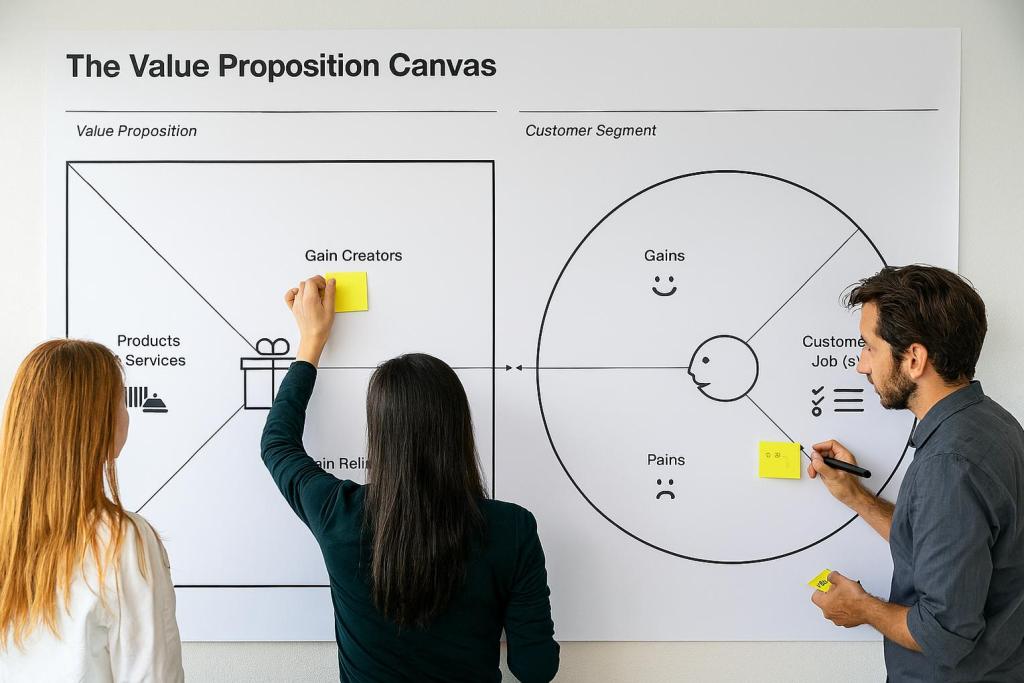
For product and service development, the
Value Proposition Canvas from Strategyzer offers a structured way to examine customer jobs, pains, gains, and the proposed solution.
The framework can help expose assumptions that have not yet been validated.
Step 4: Test the Offer Before Scaling Execution
Once the proposition is written, test it with a small group of relevant prospects.
Five to ten conversations can be a practical initial discovery exercise, although that sample cannot establish market-wide demand.
Ask prospects to explain the offer in their own words.
Then explore whether the problem matters, how they currently solve it, what would justify a change, and which evidence they would require before buying.
Do not ask only whether they like the idea.
Positive reactions are less useful than concrete information about purchasing behavior, operational constraints, and competing priorities.
The
Steve Blank’s discussion of customer development and pivots reinforces the importance of testing business assumptions against customer evidence rather than relying entirely on internal plans.
Use what you learn to revise the offer, then repeat the test.
Before launching another campaign,
sharpen your offer around a specific buyer, problem, and measurable outcome.
The Trade-Offs of Sharpening Your Offer
A clearer offer often requires difficult choices.
Narrow Positioning Versus Broad Market Appeal
Businesses sometimes resist specific positioning because they fear losing opportunities.
A software company capable of serving multiple industries may hesitate to focus its messaging on one customer segment.
But positioning does not need to define every project the company can accept.
It defines where the business wants to be recognized and how it wants to enter commercial conversations.
A company can maintain broader delivery capabilities while promoting a focused offer to a selected market.
The limitation is that overly narrow positioning can exclude viable customers or create dependence on a small segment.
The appropriate scope should reflect market evidence, delivery economics, and the company’s strategic priorities.
Customization Versus Repeatability
A highly customized offer may fit individual customers but become difficult to price, explain, and deliver consistently.
A standardized offer is easier to communicate but may not address complex customer requirements.
One practical compromise is to define a repeatable core engagement with explicitly priced extensions.
For example, an AI assessment could include a fixed discovery workshop, workflow review, feasibility evaluation, and recommendation report.
Additional integration testing or prototype development could remain optional.
This structure provides a clear starting point without pretending every customer has identical needs.
The important distinction is between flexibility that creates value and ambiguity that creates unmanaged expectations.
What to Do Next: Build a One-Page Offer
A company does not need an extensive strategy document to begin improving its offer.
It needs a short, testable statement that connects its capabilities to a customer decision.
One-Page Offer Clarity Assessment
Illustrative template for reviewing an existing business offer
| Assessment field | Question to answer |
|---|---|
| Target buyer | Who has the problem and budget? |
| Customer problem | What is not working today? |
| Existing alternative | How is the problem solved now? |
| Expected outcome | What improvement matters? |
| Solution scope | What exactly is included? |
| Differentiation | Why choose this approach? |
| Commercial model | How is the offer priced? |
| Evidence | What supports the claims? |
| Decision trigger | Why act now? |
| Next step | What commitment is requested? |
A completed assessment should make it possible for sales, marketing, and delivery teams to describe the same offer consistently.
If the teams produce materially different explanations, the proposition probably needs more work.
Three Actions to Take This Week
- Review ten recent opportunities. Identify recurring confusion, objections, and reasons for lost or delayed decisions.
- Rewrite one priority offer. Define the buyer, problem, outcome, scope, differentiation, and commercial model on a single page.
- Test it with relevant prospects. Record what they understand, what they question, and what evidence would support a buying decision.
Offer clarity is not a substitute for product quality, market demand, competitive pricing, or reliable execution.
A clear offer can still fail if the underlying problem is not important enough, the economics do not work, or the business cannot deliver the promised result.
However, clarity makes those weaknesses easier to identify before the company commits additional resources.
The objective is not to produce a more attractive description of the same business. It is to establish a proposition that customers can understand, evaluate, and act upon.
When execution is already strong but commercial progress remains inconsistent, improving the offer may be the more useful next investment.

6. FAQ
1. What is an unclear business offer?
An unclear business offer fails to communicate who the solution serves, which problem it solves, what outcome the customer can expect, or why the customer should choose it. The underlying product or service may be strong, but the proposition does not provide enough information to support a buying decision.
2. How do you know if your business offer is unclear?
Common indicators include prospects repeatedly asking what the company does, difficulty explaining differentiation, inconsistent sales messages, and frequent scope misunderstandings. Review actual customer conversations before concluding that positioning is the primary problem.
3. What is the difference between a value proposition and a business offer?
A value proposition explains why a solution matters to a specific customer. A business offer translates that value into something purchasable, including scope, deliverables, pricing, terms, and expected outcomes.
4. How can a company improve its offer without changing its product?
A company can improve its offer by identifying a more specific customer segment, describing the problem in practical terms, clarifying expected outcomes, providing evidence, and defining delivery boundaries. These changes may improve understanding without requiring product development.
5. Can unclear positioning affect sales conversion?
Yes. Unclear positioning can attract unsuitable prospects or make relevant buyers uncertain about value and differentiation. However, conversion also depends on demand, pricing, competition, trust, timing, and purchasing processes.
6. How long does it take to validate a business offer?
An initial review can often be organized over two to four weeks, depending on access to customers. A small set of interviews can identify important assumptions, but meaningful validation may require additional testing, proposals, pilots, or actual purchases.
Leave a Reply